
I have a concern that some of the wonderful automation in our planes may be dulling certain
pilotage skills. One of the problem areas for aircraft accident statistics on the Cirrus fleet are go-
arounds. In particular, the yaw dampener (YD) has come to my attention recently. It does a nice
job of handling the rudder in normal flight configurations but may not react quickly enough when
there is a sudden change from normal flight to go-around. Without timely and decisive action by
the pilot, the torque of the engine can easily overwhelm the capability of the YD. If we’re sitting
flat footed, mentally and physically, the results can be catastrophic.
The typical go-around procedure that my CSIP friends describe is to level the plane, slowly
apply full power while keeping the ball centered with the rudder, and apply forward force on the
elevator to hold altitude. Once proper climb airspeed is attained, the climb can begin. After
proper altitude and airspeed are attained, the flaps are retracted to 50% and then to full up.
The departure related accident rate suggests that something may be missing in the Cirrus
population’s execution of the go-around and/or the training about the maneuver. It has become
a regular and urgent topic at the COPA CPPP events. As a College of Aircraft Technology
presenter (I’m not a flight instructor) at COPA CPPP events, I am privy to discussions,
presentations, and instruction on the go-around topic from some of the best and most
experienced CSIPs around. Not only do we need more awareness and familiarity with the go-
around procedure, I think there may be another contributing factor that we’ve not spent much
time talking about, the yaw dampener.
Not a YD Hater
Generally, I’ve come to appreciate and accept most automation that reduces the inflight
workload for pilots. A properly functioning YD is one system that I embraced back in my days as
an avionics shop manager. The idea that something was keeping the ball centered for me
without my constant monitoring and input was truly helpful. I’m so sold on the idea that I spent
significant extra money to include YD when I upgraded my autopilot on the G1 SR22.
My G1 SR22 doesn’t have adjustable rudder trim. Most other high performance single engine
planes I’ve owned or flown had some sort of rudder trim. For a short while, Cirrus installed an
optional in-flight adjustable rudder trim on the SR22 series serial numbers 0004 through 0168,
which I thought was a great idea. Apparently, it wasn’t/isn’t very reliable, and many have been
disabled.
When Cirrus moved to Garmin Perspective, a yaw dampener (YD) was optional and is a great
substitute for adjustable rudder trim. Later the Perspective+ was introduced with YD that
automatically engages at altitudes above 200 feet AGL (like it or not). This seems like a great
idea. However, as I frequently observe, every solution has a problem.
Exposed
Recently, I was performing a post maintenance flight check on a very nice G6 (as if there are
any that aren’t very nice). During the climb I noticed the ball was way over to the right and
stayed there. Being a Perspective + equipped airplane, the yaw dampener (YD) automatically
engaged at 200 feet AGL so I expected it to keep the ball centered. I applied a little extra pressure to the right rudder to assist the YD and noticed it was engaged but was not able to center the ball. I continued to monitor the coordination into the cruise configuration and the ball
eventually almost made it to center when power was reduced to 75% for cruise.
I’ve now switched out of piloting mode and fully into mechanic troubleshooting mode (this can
be dangerous). I wanted to know if the rudder trim was properly rigged to help center the ball in
normal cruise configuration. To do this I needed to turn off the YD. There’s no YD button on the
autopilot controller so turning off the YD is either pulling the “Yaw Servo” circuit breaker or hitting
the autopilot disengage switch. The circuit breaker is a pain to locate while sitting in the plane,
so I opted for the autopilot disconnect. When pressed, the autopilot disconnect switch on the
control yoke disconnects the autopilot until the pilot manually reengages it. However, the YD is
designed to automatically reengage after just a few seconds. As soon as I hit the AP Disengage
button, the airplane dramatically yawed to the left and the ball swung full right.
This definitely isn’t the way the system should be rigged. The YD should be capable of centering
the ball in all normal flight situations if the rudder trim tab is set correctly. In this case, the tab
was set too far to the right (drives rudder to the left), and the YD was not able to overcome it in
the climb. In cruise it came very close to centering the ball. In the descent, the ball centered just
fine with the YD engaged. The culprit was exposed, and the solution was simple.
Trim Tab Adjustment
The power of the YD servo does have limits. It is powerful but not designed to overcome a
maladjusted trim tab. The rudder trim tab can only be adjusted on the ground, which means it’ll
be in the same position throughout the flight. That also means it’ll only center the ball in one
specific flight configuration.
Imagine back in the day when you were flight training in that Cessna 172. It also had a fixed
rudder trim tab. During the climb you had to hold significant right rudder to offset the engine
torque. In cruise the ball usually would be close to center. In the descent you’d probably have to
add a little left rudder. The Cirrus is no different except the YD has the ability to help so you
don’t have to be constantly tinkering with pressure on the rudder pedals.
Since the tab will only center the ball in one flight configuration, it’s reasonable to set it to do
best for the part of the flight that one spends the most time in, which is cruise. Even at that,
everyone’s cruise isn’t the same. In my G1, my flights are about 90% with me flying solo for
about 3 hours, departing with full tanks flying at about 9,000 feet at 70% power settings. That
means about 2 ½ hours in level cruise flight, starting with about 70 gallons and top of decent
having about 35 gallons. When checking for my best rudder trim tab setting, I make my test
about midway into that cruise to get the best average of natural coordinated flight. The ball will
be just a tad to the right at the beginning of the level cruise and just slightly to the left at the end
of cruise.
I won’t get into whether adjusting the rudder trim tab is a mechanic only function or if it might
qualify as preventive maintenance that an owner/pilot could do. However, the owner/pilot is
definitely the one to decide if and how much the trim tab should be moved. The Cirrus
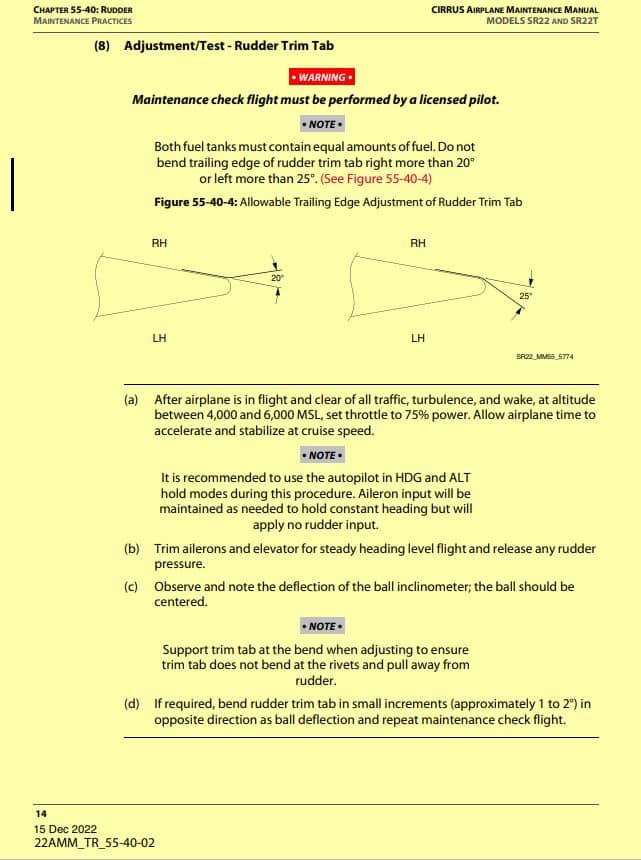
Maintenance manual covers the official version of the check and adjustment in Chapter 55-40
which I’ve included for your reference. My recommendation is to sneak up on the adjustment
with changes of one or two degrees at a time. You may be surprised how much effect that little
tab of aluminum can have on the position of the rudder.
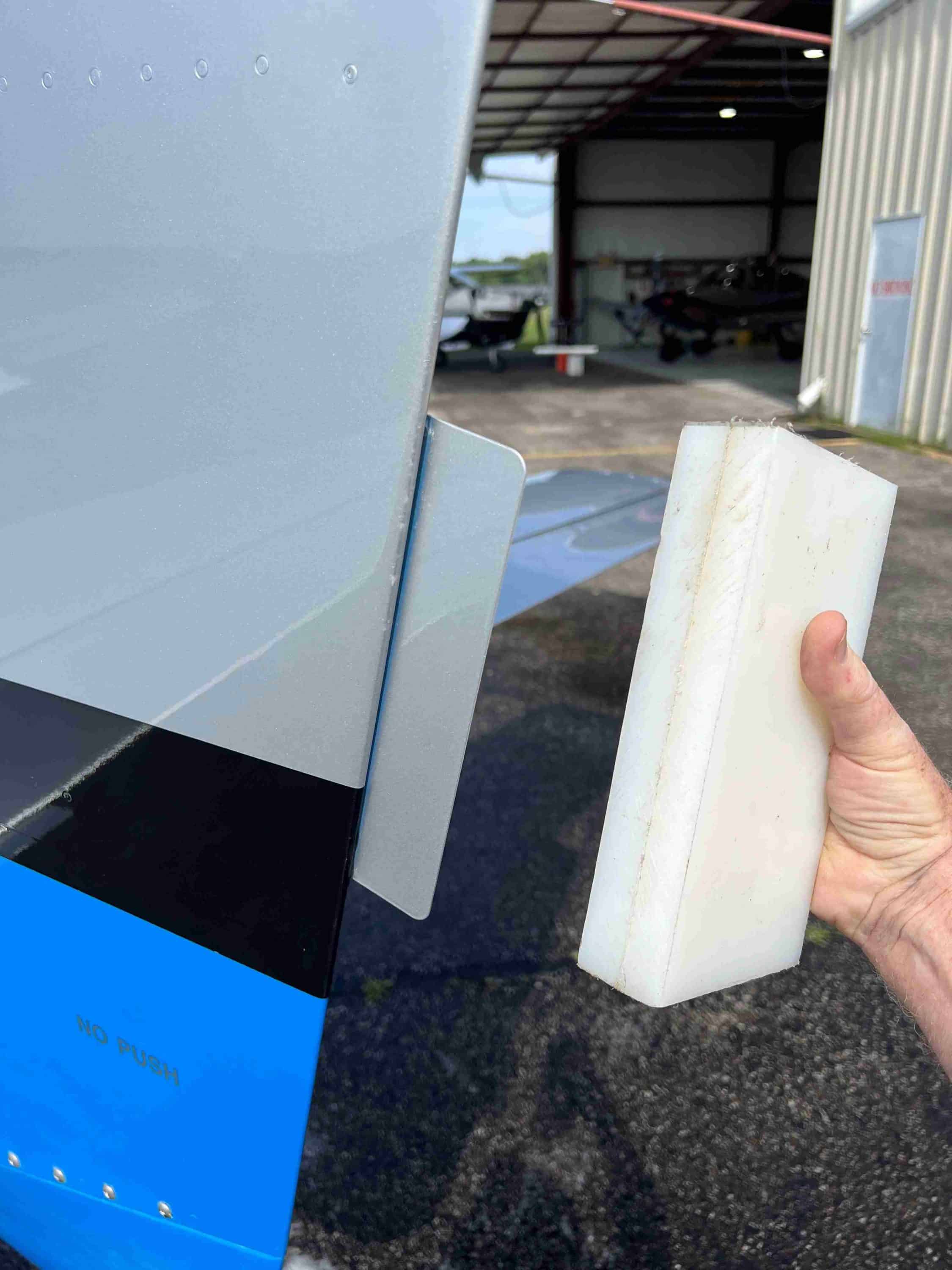
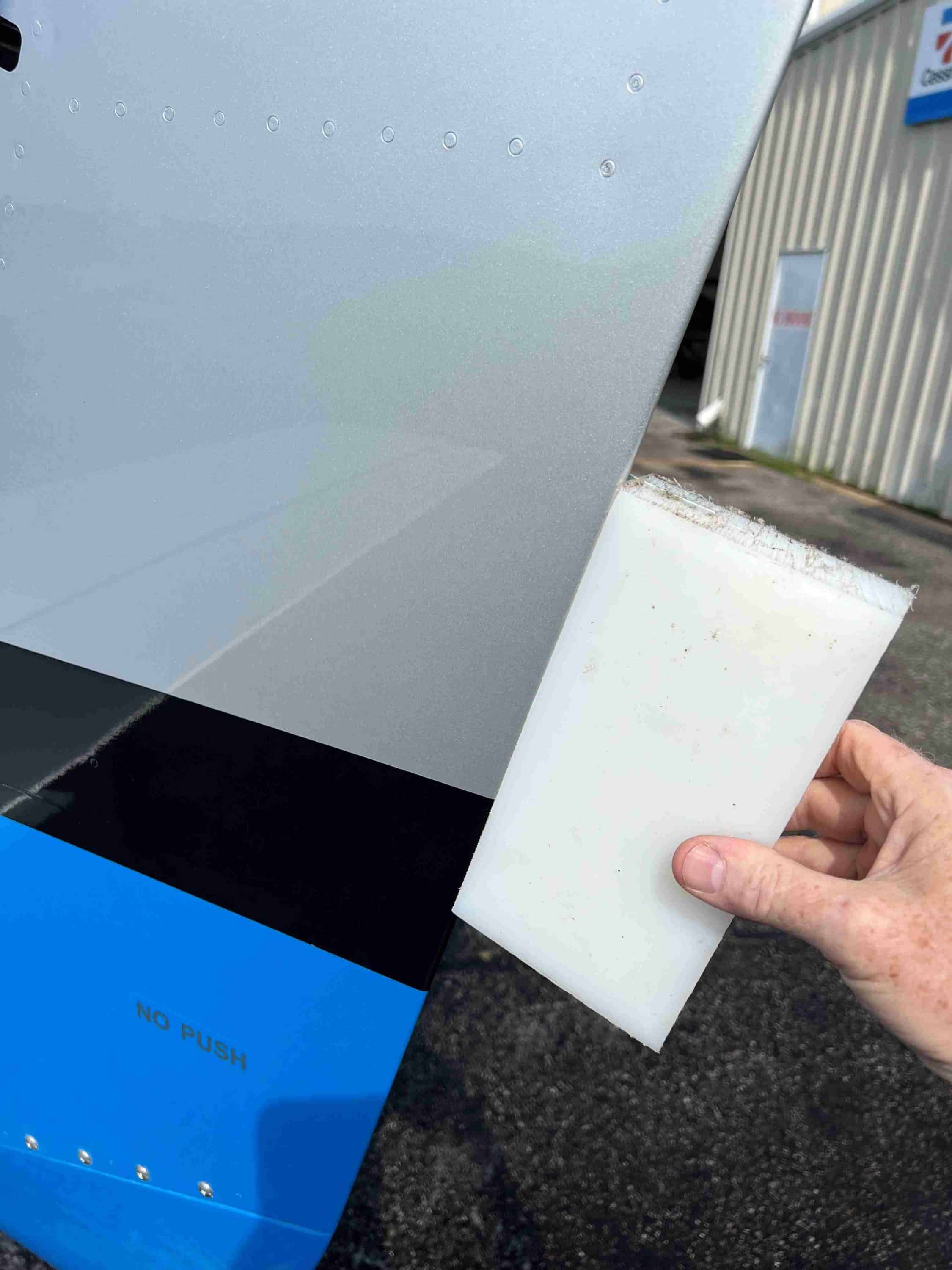
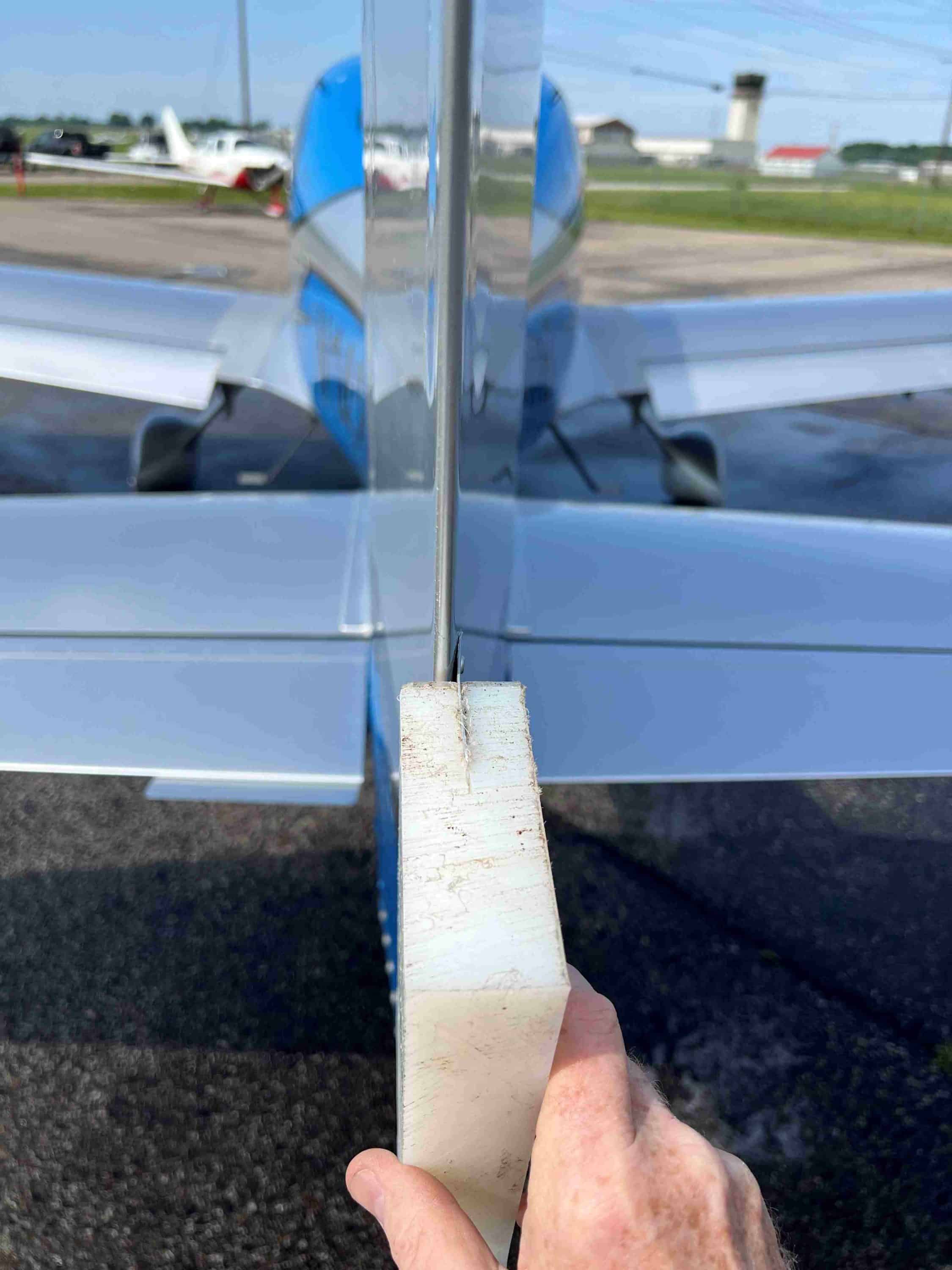
A tool for the job can be fabricated using a short piece of 2”x4” or something similar (see photo),
with a thin slit cut in the edge. Slide the tool over the trim tab until it’s very near the trailing edge
of the rudder. It’s difficult to explain the tab bending process in writing. The motion is one of
rotation of the tool, not simply bending off to one side. A twisting motion will help reduce flexing
of the rudder skin and apply most of the force to the bending point of the tab close to the rudder.
A simple tool to measure the change in deflection is a real help. You can try the TLAR (that
looks about right) method, but you’ll end up chasing it and wasting time.
No Flat Footed Flying
The next time you fly, pay particular attention to the function of the YD, not just whether it
centers the ball, but how long does it take to get there? For instance, when transitioning from
approach to full power go-around, does the YD center the ball immediately or is there a lag
time? If it lags, then the pilot will need to plan on assisting the airplane to ensure it doesn’t
decide to roll over.
Pilots are still in command and the ones responsible for ensuring all systems are functioning
properly. Even when the automation is engaged, we must be sure it’s functioning properly. Let’s
be sure the YD is doing its job, and that we are keeping our feet on the pedals during the slower
flight speeds so we’re always ready to assist the automation as it tries to keep us safe.
Cirrus has done a phenomenal job of producing a plane with high performance and minimal pilot
workload. The various automated systems that make much of this possible are truly worth
having. However, they must be maintained in good working order and the limitations
understood. No flat footed flying.
PaulNew©2024
Recent Comments