
We’ve all heard the old cliché, “I’d rather be down here wishing I were up there than being up
there wishing I were down here”. It may be old and tired, but it is true. I can attest to it having
been in a few of those situations. Our flight instructors spend a great deal of time instilling best
practices for pre-flight preparations in hopes that every flight will be a successful one. A part of
that is training on what pilots should be looking for during the takeoff roll. It’s our last chance to
check everything before we totally commit to being airborne. For takeoff we line up on the
centerline, engine page up on the MFD, and throttle up. We confirm the engine feels good and
check that the airspeed is alive. The engine page is loaded with data, but we can’t see all of it in
the excitement of the takeoff, so what should we be looking for to have confidence that the
engine is up to the task?
I’ve noticed many owners don’t seem to have a good grasp of what their engine instruments are
trying to tell them or which are the most urgent to monitor during takeoff. Everything is in a state
of change as we push that power lever forward, and it’s easy to just assume all is well because
it “feels” ok and the RPM looks about right. Pre-takeoff is loaded with all sorts of chores and
pressures, but we can’t depart with an engine that isn’t prepared to make the trip with us.
In that trusty old Skyhawk or Cherokee that we flew in our primary training, RPM is all we
needed to watch. Why would the Cirrus engine be any different? There is so much more to
know about this fire breathing 310 horsepower engine that it can be overwhelming. Fortunately,
when we understand what to look for and where to look, it only takes a second or two to
increase our confidence in our engine’s readiness.
I once asked a banker friend how their tellers were trained to spot counterfeit dollars. I expected
all sorts of details about what counterfeit bills looked like or felt like. As it turns out, they were
not given examples of counterfeits bills at all. They would handle only good bills and told that
anything that wasn’t that was counterfeit. It took me a bit to accept that, but I didn’t want to
challenge my friend. I finally realized that’s exactly how my Dad taught me to look at engine
information during takeoff. As long as the wheels are on the ground, we’re looking for outlier
data and not really interested in the cause. We can easily investigate the cause later while
sitting at a computer looking at the data. If we wait until we’re airborne, the required effort is
much more complicated.
What To Look For
Before I get too deep into this, I feel it important to make a disclaimer. Whatever procedure I
might suggest in this article is trumped by what your CSIP would tell you. Your flight instructor is
flying next to you, making in-person observations of your flying skills and procedures and has a
much better understanding of what you need in any specific situation. I’m just a mechanic that
also happens to fly a G1 SR22 and geeks out on the available data. Obviously, I feel it is very
important and urgent to notice the engine data during takeoff but it is more important to follow
the guidance of your flight instructor.
Fuel Flow
Deciding what to look for first is an interesting thought and some operators will disagree. Fuel
flow (FF) came to the top for me. Fuel flow is driven by engine RPM and manifold pressure. In
the turbo-charged aircraft, FF is very easy because the maximum should be the same
regardless of airport altitude. The nonturbo aircraft, like mine, require some mental adjustments
to allow for various density altitudes. The point remains that if the maximum fuel flow is correct,
the maximum RPM and manifold pressures are likely very close to correct as well. FF is
basically a three for one deal. If you don’t know what the correct maximums are, just have a
look in Section II of your POH.

Oil Pressure
Oil pressure (OP) is a good second parameter to check. Of course, oil pressure was just
checked in the engine run up, but this time it will be at max RPM. Oil pressure is driven by
engine RPM and oil temperature. If this is the first flight of the day and oil temperature is around
150°F, the viscosity will be high and the pressure will be on the high side, possibly at the top of
the yellow. If this is the second takeoff of the day with a hot engine and oil with temperature at
around 180°F, the oil pressure will be closer to the cruise flight pressure of 50 to 60 p.s.i. It only
takes a very small piece of debris in the oil pressure regulator valve to suddenly drop the
pressure to the low end of the scale. Overly high oil pressure is a rare problem, but low oil
pressure occurs more than we’d like and is an indication of a problem.
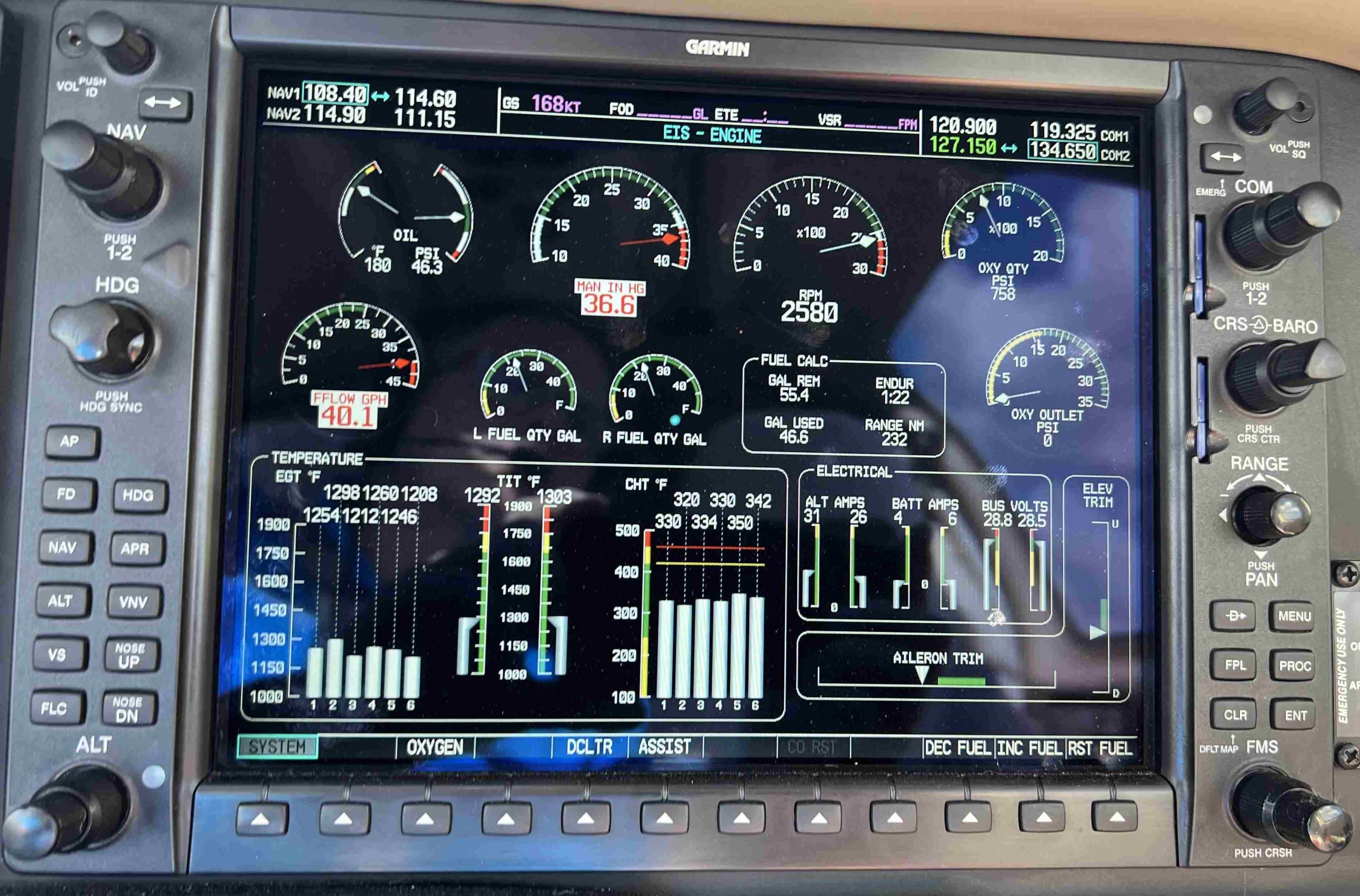
Exhaust Gas Temperature
The most dynamic of the engine parameters to watch are the exhaust gas temperatures (EGT).
There are six of them and they are moving around significantly during initial takeoff throttle up.
We’re watching for outliers, not so much for the minute details, which simplifies the visual scan.
Once the power lever is full forward and the temps have stabilized, the EGTs normally land
somewhere between 1300° F and 1350°F if your engine is set up properly. Once they settle you
can have a quick glance to see what they are telling you.
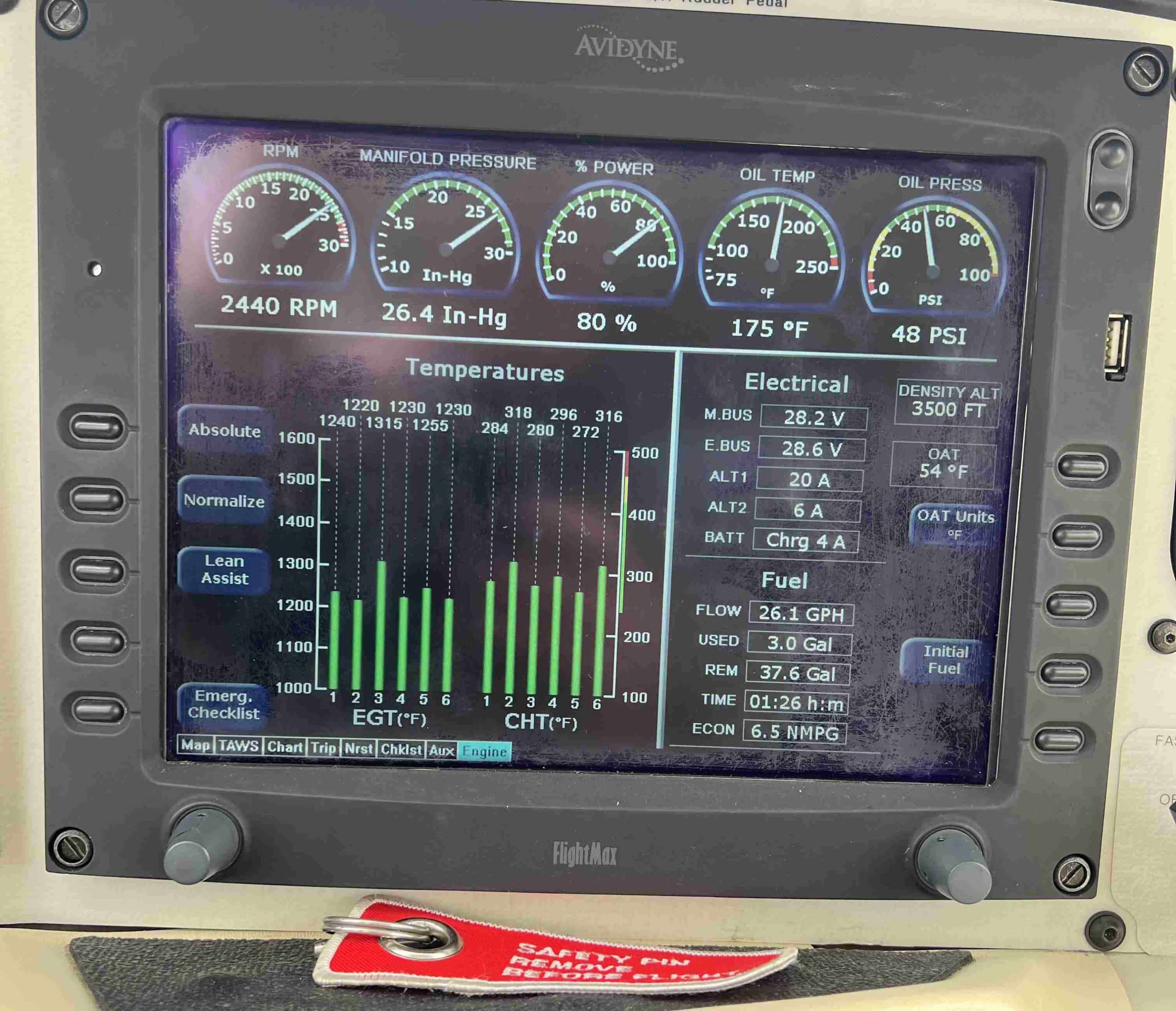
If all six EGTs are higher than normal, you may be operating on one mag. This usually happens
because somebody didn’t switch the ignition key all the way back to “both” after the magneto
check during run up. Running on one magneto (just one spark plug per cylinder) robs the engine
of much needed power. If a single EGT is higher than its cohort, it could be an indication of a
failed spark plug or a partially restricted injector. A single EGT that drops lower than the rest is
very likely a significantly restricted fuel injector. A slightly restricted injector causes the one
cylinder to run a little leaner than the others and could result in heavy detonation during the
initial climb. A severely restricted injector would cause the one cylinder to run so lean that it may
not even fire.
What Else?
We could scan the cylinder head temperatures (CHT) but those move slowly and usually aren’t
very revealing until the climb out. Percent power is one of my least favorite indicators because
it’s a calculation and can create alarm if not properly understood. Volts and amps are one of my
favorites but don’t reveal much about the engine, so that’ll be another discussion as well.
Everyone should decide how much data they can consume during the takeoff roll. Remember,
this isn’t a detailed performance check, it’s a “go no-go” check. Performance review would be
something to do away from the airport or after the flight by reviewing the data. For takeoff we want to know the engine is functioning normally and that we can successfully and safely
complete our mission.
Once comfortable with what to look for and where it is displayed, it only takes a quick glance to
know where everything is. If one is looking for the minimum items to check, I’d suggest picking
the fuel flow for its three-in-one possibilities. The FF settles very quickly after full throttle
application so it’s a valuable one to use for a first look. Oil pressure is a good second item to
note and won’t be too taxing to pick up on during that first look at the fuel flow.
After the throttle is full forward and you’ve had that first look at the engine data, the airspeed
indicator should be waking up. About the time you note the airspeed is “alive” the EGTs should
be settling. This is a good time for another quick glance at the engine monitor to verify the
EGTs. By now you’re scooting down the runway and ready for rotation.
Once we connect the dots between the various engine data displayed, incorporating more
meaningful looks yields huge returns. Confidence in the flight before rotation can be a very
comforting feeling. No need for guessing or hoping when we know what to look for and what it
means. Let’s set ourselves up for success right from the start.
PaulNew©2024
Recent Comments